
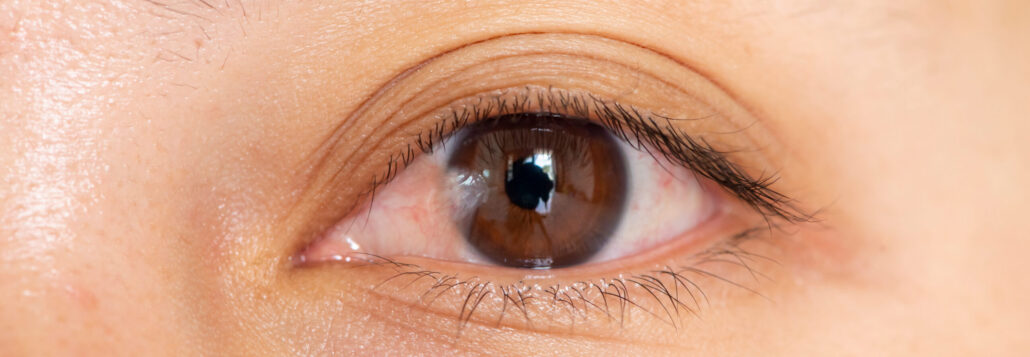
1. What Is a Pterygium?
It is not cancerous, but it can become a problem if it grows too far.
It’s a wedge-shaped growth of tissue that starts on the white part of the eye (conjunctiva) and can grow toward the cornea (the clear front part of the eye).
Think of it like a little intruder. It slowly creeps across the surface of your eye.
2. Why does a pterygium happen?
Pterygium is caused by long-term irritation of the eye, especially from:
- Ultraviolet (UV) light from the sun
- Wind, dust, and dry air
- Smoke and pollution
- Dry eye and irritation
3. The Slow Progression
Pterygium grows slowly, often over months or years.
It can start small and stay that way for a long time — or it can continue growing.
The more irritation, the faster it may grow.
Early stage
A tiny growth appears on the white part of the eye.
A growing
The growth gets larger and moves closer to the cornea.
Advanced
It can extend onto the cornea and may start to affect vision.
There may not be symptoms at first. Many people don’t notice it until it becomes larger.
4. How does it affect you?
As it grows, a pterygium can cause:
Redness — The eye may look red or bloodshot.
Irritation or burning — It may feel scratchy, sore, or irritated.
Dryness — Your eyes may feel dry or gritty.
A feeling like something is in your eye — It may feel like sand or a small particle is stuck in your eye.
Blurred vision (if it grows onto the cornea) — If the growth reaches the clear front part of the eye, it can affect vision.
Everyone’s experience is different. Some people have mild symptoms. Others may be more bothered as it grows.
5. Can you prevent a pterygium?
You can’t always prevent pterygium, but you can lower your risk.
- Wear UV-blocking sunglasses — Protect your eyes from harmful sunlight.
- Use a wide-brim hat — More shade means less UV exposure.
- Keep your eyes lubricated — Lubricating eye drops help with dryness and irritation.
- Avoid smoke, dust, and irritants — These can make irritation worse.
- Get regular eye exams — Your eye doctor can catch changes early.
Small steps today can protect your vision tomorrow. Healthy habits go a long way in keeping your eyes comfortable and clear.
6. What does it look like?
A pterygium is a triangular, fleshy growth that usually starts on the inner (nose) side of the white part of the eye.
It can vary in size. Some stay small, while others grow farther onto the cornea.
Every pterygium looks a little different, but they all have the same basic shape and features.
Head — The front edge that moves onto the cornea.
Body — The part that covers the white of the eye.
Base — The part attached to the conjunctiva.
Key point: A pterygium is not a cancer. But because it can grow and affect your vision, it’s important to have it checked by an eye doctor.
7. Can a pterygium be treated?
If a pterygium bothers you or affects your vision, your eye doctor can help.
Eye drops — Lubricating or anti-inflammatory drops can help relieve redness and irritation.
Manage risk factors — Protect your eyes from the sun and wind, and treat dryness to slow progression.
Surgery — If needed, surgery can remove the growth. Your doctor will decide what’s best for you.
Early check-ups make a big difference. The sooner it’s found, the easier it is to manage. Talk to your eye doctor if you notice changes in your eyes.
Remember: You can’t always stop a pterygium, but with the right care, you can protect your eyesight and keep your eyes comfortable.
8. Talk to your eye doctor
Your optometrist or ophthalmologist can examine your eyes and help you understand your options.
A check today — A simple eye exam can detect a pterygium early, even before symptoms get worse.
Personalized advice — Your doctor will explain what’s happening and recommend the best next steps for you.
Discuss treatment options — From managing symptoms to surgery, your doctor will guide you to the right choice.
Protect your vision — Working together, you and your eye doctor can help keep your eyes healthy for years to come.
You’re not alone. Millions of people have pterygium. With the right care, you can protect your vision and keep doing the things you love.
Schedule your eye exam — It’s a quick step that can make a big difference.
9. You’re not alone
Different people. Different lives. Same condition. With awareness and care, you can protect your vision.
Common worldwide — Affects more than 25 million people around the world.
Millions in the U.S. — An estimated 15 million people in the U.S. have pterygium.
More risk, more common — People who spend more time outdoors in sunny, windy, or dusty places are at higher risk.
You’re not alone — Many people manage it successfully with the right care and healthy habits.
You’re part of a community. Talk to your eye doctor, follow their advice, and take steps today for a clearer tomorrow.
Your eyes. Your future. Small steps now can help you see the moments that matter most.
Disease burden and prevalence
An estimated 15 million people in the United States are affected by pterygium, reflecting its status as a common ocular surface disease rather than a rare finding.
Each year, roughly half of these individuals, or about 7.5 million people, see an eye care professional for symptoms such as irritation, redness, or blurred vision. Of these visits, approximately 3.7 million patients receive a formal diagnosis of pterygium, and close to 100,000 ultimately undergo surgical removal when the lesion becomes visually significant or highly symptomatic.
15M People impacted by pterygium in the U.S.
7.5M Patients are seen by an eye doctor annually
3.7M Diagnosed and treated as per ICD-10 by an ophthalmologist or medical optometrist
100,000 Patients undergo surgery annually (Cost: $1,1300)
Source: https://iovs.arvojournals.org/article.aspx?articleid=2789789
NEXT STEP: Watch these pterygium videos for more visual information
Epidemiology reviews (e.g., BMJ Open meta‑analysis and NIH/PMC reviews) describe pterygium as a “common ocular surface disorder,” with global pooled prevalence around 10%, and U.S. prevalence varying by latitude (5–15% in certain bands). Source: https://emedicine.medscape.com/article/1192527-overview
These support the “common ocular surface disease” positioning but not the specific U.S. numerics you list beyond the 10–15M range. Source: https://pmc.ncbi.nlm.nih.gov/articles/PMC5968422/